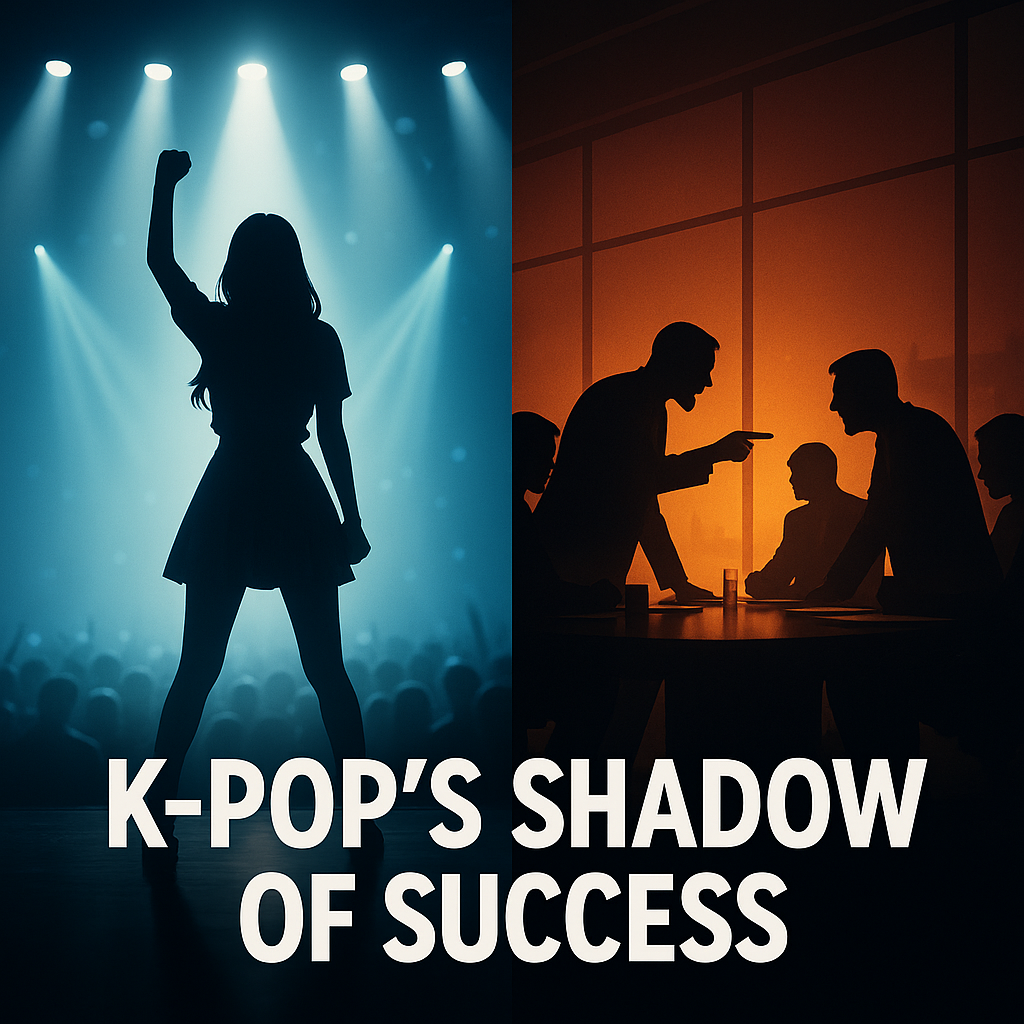
Deep Dive Lab: The Dark Side of the K-Pop Miracle — Why the System Fails to Protect Its Own Artists
— A Human-versus-Profit Analysis Inside the Global Entertainment Machine
---
Introduction (Hook) — Cracks in a Perfect Fantasy: Inside K-Pop’s Psychological Battlefield
To the world, K-Pop looks flawless—synchronized choreography, immaculate styling, spotless smiles.
But behind that perfection is a system that has repeatedly failed to protect the very people who power it.
Two recent events made this painfully clear:
The Nana Home Invasion: A top star forced to physically fight off an armed intruder inside her own home.
The NewJeans Corporate War: A courtroom drama revealing how artists become collateral damage in boardroom power struggles.
Both incidents raise a single, uncomfortable question:
> How can the world’s most efficient entertainment system fail so spectacularly at protecting the humans inside it?
This Deep Dive explores the physical, structural, and economic reasons behind that failure.
---
Part 1 — The Architects of Success: K-Pop’s Efficiency Paradox and the Human Cost
K-Pop is often praised as the world’s most optimized “idol-manufacturing system.”
Its training models, production schedules, and global content pipelines are engineered for speed, scale, and perfection.
But the same qualities that make the system powerful also make its artists vulnerable.
The Efficiency Paradox
High performance demands → Chronic burnout
Strict control + constant monitoring → Fragile mental health
Exhaustive schedules → No personal margin for recovery
In short, the system is incredibly good at creating idols—
but dangerously bad at sustaining them as human beings.
The industry silently depends on human exhaustion as a resource.
---
Part 2 — The Failed Fortress: When Billion-Dollar Companies Can’t Secure a Door
For years, fans worried about sasaengs (stalkers).
But the recent incident involving Nana exposed a much more primal fear: Physical Safety Failure.
Nana’s Nightmare: Fighting for Survival
In November 2025, Nana—one of Korea’s most recognized stars—was not protected by bodyguards or high-tech security.
She was forced to physically fight off an armed intruder who broke into her home.
She survived not because of the system, but because of her own desperate struggle.
The Question the World is Asking
How can an artist generating millions in revenue be left so vulnerable in her own living room?
This incident shattered the illusion of the "K-Pop Fortress."
It proved that while agencies spend fortunes on music videos and outfits, they often underinvest in the most basic necessity: Secure Housing and Physical Protection.
If a random intruder can breach the sanctuary of a top idol, the system’s promise of “management and care” is nothing more than a myth.
The barrier between a star’s safety and public danger is terrifyingly thin.
---
Part 3 — The Boardroom Betrayal: The NewJeans War & K-Pop’s Structural Achilles’ Heel
While Nana fought a physical threat, NewJeans faced a structural one.
Even for those outside Korea, this conflict became global news, but many missed what it truly revealed.
This wasn’t just a messy corporate fight.
It was the symptom of a deep, structural flaw in K-Pop’s business model.
The War Behind the Music
The conflict unfolded between ADOR (the label) and HYBE (the giant parent company).
Allegations flew, but at its core, the crisis showed this:
> In K-Pop’s corporate structure, artists often become collateral in battles for ownership and control.
Like warriors on a battlefield they never chose, NewJeans became pawns in a struggle between:
Capital (The Investors)
Creative Leadership (The Producers)
K-Pop’s global excellence was built on corporate efficiency—
but its greatest vulnerability is a governance model where no one is incentivized to prioritize artist stability over shareholder profit.
---
Conclusion — The Road to K-Pop 2.0: When the System Finally Learns to Protect the Human
K-Pop can no longer rely on perfection, performance, and PR to mask systemic cracks.
To survive sustainably, the industry needs a full structural upgrade:
---
✅ 1. A Fortress That Actually Protects
Security is not a luxury; it is a baseline.
Agencies must mandate high-level residential security and physical protection protocols for all artists, ensuring no star ever has to fight for their safety at home again.
---
✅ 2. Transparent Governance That Doesn’t Betray Creators
The industry needs artist-centered contracts and clear ownership rules that shield creative talent from corporate power struggles.
---
The Future of K-Pop
If K-Pop wants to maintain its global cultural power, the system must evolve from:
A machine built for perfection → A system built for humans.
Only then can the next generation of artists thrive without fear—
whether in the boardroom or in their own living rooms.
---
[Deep Dive Lab. End]
'Deep Dive Analysis' 카테고리의 다른 글
| Survive or Die: Korea's $270B Bet (0) | 2025.12.01 |
|---|---|
| Trump's SOS: Why He Needs K-Defense (0) | 2025.11.29 |
| Korea's Price-Gouging Shock (0) | 2025.11.25 |
| Is the US-ROK Submarine Deal a Game Changer? (1) | 2025.11.23 |
| Deep Dive: The Philosophy of Korean Monochrome Fashion (0) | 2025.11.21 |